What’s up, everyone – if you’re in the market for bimetal bushings, you already know they’re the unsung heroes of so many industrial applications. From heavy machinery in construction to precision gearboxes in automotive, these dual-layer parts (usually a steel back and a sintered bronze lining) handle way more stress than most people realize. But let’s cut to the chase: one factor that tests these bushings more than almost any other? Pressure. And as a supplier who’s been working with bimetal bushings for years, I’ve seen firsthand how pressure can make or break a bushing’s performance – if you understand what to look for, that is. Bimetal Bushings
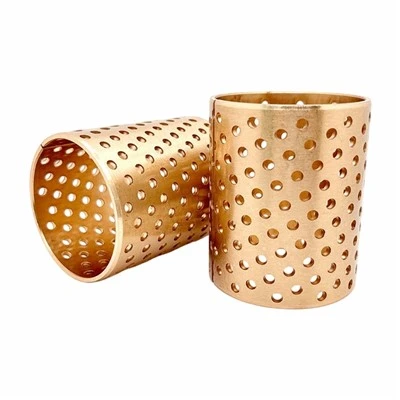
First off, let’s get one thing straight: not all pressure is bad. Wait, hear me out. Bimetal bushings are designed to carry radial loads, right? That’s the pressure that pushes perpendicular to the shaft, like when a excavator’s arm sits on its pivot pin. A little consistent, controlled pressure isn’t just okay – it’s how the bronze lining forms that critical lubrication film between the bushing and shaft. The bronze is porous, so it holds oil, and when load comes on, that oil squeezes out just enough to keep metal-to-metal contact from happening. I’ve got a customer who uses our standard bimetal bushings in their farm tractor pivot points – they run steady at around 25 MPa, and those bushings last three times longer than single-metal bronze ones they used before. That’s the sweet spot: moderate, constant pressure lets the bushing do its job without overworking it.
But the problem starts when pressure spikes, or when it’s uneven. Let’s talk about peak pressure first – that’s the sudden, short-term load, like when a forklift slams a pallet down or a rock hits a construction hammer’s pivot. Bimetal bushings have a load limit, and pushing past that doesn’t just make them wear faster; it messes with the bond between the steel back and the bronze lining. See, that bond is key. The two layers are usually metallurgically bonded (no adhesive here) – steel for strength, bronze for friction. If peak pressure is too high, say over 70 MPa for some of our off-the-shelf bushings, the bronze lining can deform. It’s soft, so when you hit it with a spike, it can bulge or even delaminate from the steel. I had a client a couple years back who skipped the reinforced bushings for their rock crusher, thinking standard ones would work. After a week, half the bushings had the bronze layer peeling right off the steel back – cost them downtime worth way more than the right parts.
Then there’s uneven pressure. This is a big one that a lot of engineers overlook. If your shaft isn’t aligned perfectly, or if your housing has a tiny burr, the pressure on the bushing isn’t spread out evenly. One spot takes all the load, and that’s where wear happens fast. For example, a bushing in a misaligned gearbox might have 40 MPa on one edge and 10 MPa on the other. The high spot will wear through the lubrication film in days, not weeks, and the bronze will start to score. I actually tested this last quarter – took two identical bushings, put one in a aligned test rig and one in a slightly misaligned one. After 100 hours, the misaligned bushing had 3x more material lost on the high side. That’s why we always tell customers to check their shaft and housing alignment before installing – no use in great bushings if the setup’s wrong.
Another area where pressure plays tricks is fatigue. Bimetal bushings don’t just carry load once – if you’re talking about moving parts, that load cycles over and over. Like a car’s wheel hub bushing, which spins thousands of times a minute. When cyclic pressure happens, even if each cycle is under the peak limit, you can get metal fatigue in the bronze. The tiny pores start to crack, and over time, those cracks spread. I’ve seen bushings that ran at 55 MPa cyclic load for a year develop fatigue cracks, but when we upgraded them to a grade with a denser bronze lining, the cracks didn’t show up for three years. It’s not just about total load – it’s about how many times that load repeats.
Wait, let’s not forget about edge pressure. A lot of bushings have a slight chamfer on the ends to prevent this, but if you’re cutting corners and skipping that, pressure can get concentrated at the edges. That’s where the bronze can fold over, or the edge can chip off. I once got an emergency order from a wind turbine maintenance team – their bushings had chipped edges, and they needed replacements same day. We had to rush a batch with a standard chamfer, and now we make sure to note edge pressure in our tech sheets for any customer dealing with high-cycle, high-load parts.
Now, what about how we design our bimetal bushings to handle all this? As a supplier, we don’t just sell a one-size-fits-all part. We have different grades: our standard grade is for moderate pressure (up to 40 MPa), our heavy-duty grade is for peaks up to 65 MPa, and our reinforced grade has a thicker, stronger bronze lining and a better steel-bronze bond for up to 80 MPa. We also add features like oil grooves that are strategically placed to spread pressure more evenly – instead of having a big groove in the middle, we use multiple small ones that let lubricant reach all sides, so no single spot gets overloaded.
Something I wish more people knew: pressure and lubrication go hand in hand. If you don’t have enough lubricant, even moderate pressure will wear out a bushing fast. But too much lubricant can wash away the oil film when pressure is high. It’s a balance. We always tell customers to match their lubrication type to their pressure – for high-pressure applications, a thicker EP (extreme pressure) oil works best, because it doesn’t break down under load. Last year, a mining company switched from regular gear oil to EP oil on our heavy-duty bushings, and their wear rate dropped by 40% – all because they adjusted the lubrication to handle the pressure.
Let’s talk about a real fail story that stuck with me. A couple years back, a construction company used our bimetal bushings in their excavator’s swing bearing. They ran the excavator 12 hours a day, every day, and the swing bushing was taking constant radial pressure plus occasional shock loads. They installed standard grade bushings, and within three months, two of them had delaminated. When they called me, we checked their specs – their swing load was averaging 50 MPa, with peaks up to 75 MPa. That’s way over the standard grade’s limit. We sent them our reinforced grade bushings, and they haven’t had an issue since. The difference? We adjusted the bushing’s bond strength and bronze thickness to handle that higher pressure.
So, what should you take away from all this? Pressure isn’t just a number – it’s a combination of how much load you’re under, how often it cycles, how evenly it’s spread, and how your bushing is built. If you’re working with high pressures (over 40 MPa, to keep it simple), you can’t use a generic bushing. You need one that’s made to handle that load, with a strong steel-bronze bond, a durable bronze lining, and maybe some features to spread pressure evenly.
If you’re not sure what pressure your application is dealing with, or if you’re tired of bushings failing because of pressure issues, we’re here to help. We’ve worked with everything from farm equipment to wind turbines, and we can help you pick the right bimetal bushing for your load, your cycle, and your setup. No guesswork, no jargon – just straight talk about what works for your application.
We get that downtime costs you money, so we make sure our bushings are built to stand up to whatever pressure you throw at them. If you’re in the market for bimetal bushings that perform under pressure, reach out to us. We can walk through your needs, answer any questions, and get you the right parts fast.
Bimetal Strips & Sheets References:
- Design of Machine Elements, M.F. Spotts, T.E. Shoup, and L.C. Hornberger, Prentice Hall, 2004.
- Tribology for Engineers, J. Halling, Macmillan, 1975.
- Bimetallic Bearings: Materials, Design, and Applications, T.A. Stolarski, Woodhead Publishing, 2000.
Qingzhou Baiyun Anti-friction Products Co., Ltd.
With abundant experience, we are one of the most professional bimetal bushings manufacturers and suppliers in China. Please rest assured to wholesale customized bimetal bushings at competitive price from our factory. Welcome to contact us for quotation.
Address: Linglongshan North Road (south of the railway bridge), Economic Development Zone, Qingzhou City, Weifang City, Shandong Province
E-mail: byantifriction@gmail.com
WebSite: https://www.baiyunbimetal.com/
